
Lesson3 端到端模型执行

1 端到端模型整合

示例模型:两层神经网络,包含两个全连接层和一个relu激活层
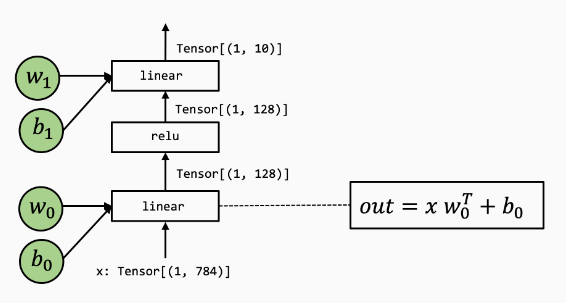
先从模型的Numpy实现开始:

1
2
3
4
5
def numpy_mlp(data, w0, b0, w1, b1):
lv0 = data @ w0.T + b0
lv1 = np.maximum(lv0, 0)
lv2 = lv1 @ w1.T + b1
return lv2

上面的示例代码显示了利用高层NumPy数组操作,执行端到端模型执行的过程。

为了说明底层细节,我们将再次用底层 NumPy 编写示例:

  • 我们将在使用循环而不是数组函数来演示循环计算。
  • 我们总是通过 np.empty 显式分配数组并传递它们。(不包含数组初始化)

下面的代码展示了同一模型的底层Numpy实现:

1
2
3
4
5
6
7
8
9
10
11
12
13
14
15
16
17
18
19
20
21
22
23
24
25
26
27
28
29
30
31
32
33
34
35
36
37
38
39
40
41
42
43
44
45
# 全连接层0
def lnumpy_linear0(X: np.ndarray, W: np.ndarray, B: np.ndarray, Z: np.ndarray):
Y = np.empty((1, 128), dtype="float32")
for i in range(1):
for j in range(128):
for k in range(784):
if k == 0:
Y[i, j] = 0
Y[i, j] = Y[i, j] + X[i, k] * W[j, k]

for i in range(1):
for j in range(128):
Z[i, j] = Y[i, j] + B[j]

# relu激活层
def lnumpy_relu0(X: np.ndarray, Y: np.ndarray):
for i in range(1):
for j in range(128):
Y[i, j] = np.maximum(X[i, j], 0)

# 全连接层1
def lnumpy_linear1(X: np.ndarray, W: np.ndarray, B: np.ndarray, Z: np.ndarray):
Y = np.empty((1, 10), dtype="float32")
for i in range(1):
for j in range(10):
for k in range(128):
if k == 0:
Y[i, j] = 0
Y[i, j] = Y[i, j] + X[i, k] * W[j, k]

for i in range(1):
for j in range(10):
Z[i, j] = Y[i, j] + B[j]

# 整体模型
def lnumpy_mlp(data, w0, b0, w1, b1):
lv0 = np.empty((1, 128), dtype="float32")
lnumpy_linear0(data, w0, b0, lv0)

lv1 = np.empty((1, 128), dtype="float32")
lnumpy_relu0(lv0, lv1)

out = np.empty((1, 10), dtype="float32")
lnumpy_linear1(lv1, w1, b1, out)
return out

2 在TVMScript中构建端到端IRModule

以低级Numpy为示例,现在准备利用MLC抽象来实现端到端模型运行,以下是TVMScript实现

1
2
3
4
5
6
7
8
9
10
11
12
13
14
15
16
17
18
19
20
21
22
23
24
25
26
27
28
29
30
31
32
33
34
35
36
37
38
39
40
41
42
43
44
45
46
47
@tvm.script.ir_module
class MyModule:
@T.prim_func
def relu0(x: T.handle, y: T.handle):
n = T.int64()
X = T.match_buffer(x, (1, n), "float32")
Y = T.match_buffer(y, (1, n), "float32")
for i, j in T.grid(1, n):
with T.block("Y"):
vi, vj = T.axis.remap("SS", [i, j])
Y[vi, vj] = T.max(X[vi, vj], T.float32(0))

@T.prim_func
def linear0(x: T.handle,
w: T.handle,
b: T.handle,
z: T.handle):
m, n, k = T.int64(), T.int64(), T.int64()
X = T.match_buffer(x, (1, m), "float32")
W = T.match_buffer(w, (n, m), "float32")
B = T.match_buffer(b, (n, ), "float32")
Z = T.match_buffer(z, (1, n), "float32")
Y = T.alloc_buffer((1, n), "float32")
for i, j, k in T.grid(1, n, m):
with T.block("Y"):
vi, vj, vk = T.axis.remap("SSR", [i, j, k])
with T.init():
Y[vi, vj] = T.float32(0)
Y[vi, vj] = Y[vi, vj] + X[vi, vk] * W[vj, vk]
for i, j in T.grid(1, n):
with T.block("Z"):
vi, vj = T.axis.remap("SS", [i, j])
Z[vi, vj] = Y[vi, vj] + B[vj]

@R.function
def main(x: R.Tensor((1, "m"), "float32"),
w0: R.Tensor(("n", "m"), "float32"),
b0: R.Tensor(("n", ), "float32"),
w1: R.Tensor(("k", "n"), "float32"),
b1: R.Tensor(("k", ), "float32")):
m, n, k = T.int64(), T.int64(), T.int64()
with R.dataflow():
lv0 = R.call_dps_packed("linear0", (x, w0, b0), R.Tensor((1, n), "float32"))
lv1 = R.call_dps_packed("relu0", (lv0, ), R.Tensor((1, n), "float32"))
out = R.call_dps_packed("linear0", (lv1, w1, b1), R.Tensor((1, k), "float32"))
R.output(out)
return out

对上述程序进行如下部分注释:

  1. T.handleT.match_buffer():表示数据缓冲区的抽象数据类型,表示一个数据对象但是不会指定其具体的形状、数据类型或内存位置。通过 T.match_buffer 函数,可以将抽象的 T.handle 转换为具体的 T.Buffer 对象。
  2. R.function:Relax函数是一种表示上层神经网络执行的全新抽象。

3 在 TVMScript 中构建端到端 IRModule

3.1 计算图
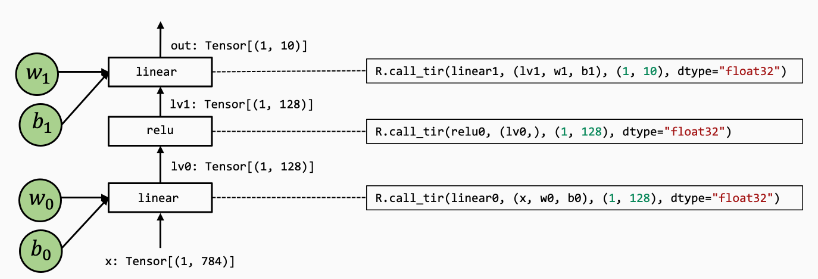
使用图(graph)来可视化高层模型执行通常很有帮助。上图是main函数的计算图视图:

  • 图中的每个框都对应于计算操作。
  • 箭头对应于中间张量的输入输出。

图本身可以看作是一种抽象,在机器学习框架中通常称为计算图 (computational graph)

3.2 call_dps_packed

计算图中的每个操作步骤都包含一个R.call_dps_packed操作。 这是引入元张量函数的过程:

1
lv0 = R.call_dps_packed("linear0", (x, w0, b0), R.Tensor((1, n), dtype="float32"))

为了解释R.call_dps_packed,先看一下操作等效底层Numpy实现(参考实现),如下所示:

1
2
3
4
def lnumpy_call_dps_packed(prim_func, inputs, shape, dtype):
res = np.empty(shape, dtype=dtype)
prim_func(*inputs, res)
return res

具体来说,call_dps_packed接受一个原函数(prim_func)的输入列表,并分配一个输出张量res,然后将输入和输出传递给prim_func。执行prim_func后,结果会填充到res中,然后返回结果。

为什么需要call_dps_packed这样一个函数呢?因为元张量函数采用以下约定

1
2
def low_level_prim_func(in0, in1, ..., out):
# implementations

此约定称为:目标传递(destination passing),具体来说,输入和输出在外部显式分配并传递给底层元函数(即代码中的prim_func)。这种风格通常用于底层库设计,因此高层框架可以处理内存分配决策。

**注:**并非所有张量操作都可以通过这种方式呈现(比如,有些操作的输出形状取决于输入)

这里的关键思想是我们想要隐藏可能的分配或对函数的显式写入。 用更正式的术语来说,我们希望函数是 pureside-effect free。如果一个函数只从其输入中读取并通过其输出返回结果,它不会改变程序的其他部分(例如递增全局计数器),那么它是pureside-effect free的。

我们可以据此将底层Numpy代码重写为:

1
2
3
4
5
def lnumpy_mlp_with_call_dps_packed(data, w0, b0, w1, b1):
lv0 = lnumpy_call_dps_packed(lnumpy_linear0, (data, w0, b0), (1, 128), dtype="float32")
lv1 = lnumpy_call_dps_packed(lnumpy_relu0, (lv0, ), (1, 128), dtype="float32")
out = lnumpy_call_dps_packed(lnumpy_linear1, (lv1, w1, b1), (1, 10), dtype="float32")
return out

3.4 Dataflow Block

dataflow block是我们标记程序计算图区域的一种方式。 具体来说,在dataflow block中,所有操作都需要side-effect free。 在dataflow block之外,操作可能包含side-effect。示例如下:

1
2
3
4
5
6
7
8
9
10
11
12
13
14
15
16
17
@R.function
def main(x: R.Tensor((1, "m"), "float32"),
w0: R.Tensor(("n", "m"), "float32"),
b0: R.Tensor(("n", ), "float32"),
w1: R.Tensor(("k", "n"), "float32"),
b1: R.Tensor(("k", ), "float32")):
m, n, k = T.int64(), T.int64(), T.int64()

with R.dataflow():
lv0 = R.call_dps_packed("linear0", (x, w0, b0), R.Tensor((1, n), "float32"))
gv0 = R.call_dps_packed("relu0", (lv0, ), R.Tensor((1, n), "float32"))
R.output(gv0)

with R.dataflow():
out = R.call_dps_packed("linear0", (gv0, w1, b1), R.Tensor((1, k), "float32"))
R.output(out)
return out

4 构建并运行模型

调用 relax.build 来构建这个函数。 注意:Relax 仍在开发中,因此某些 API 可能会更改。 不过,我们的主要目标是熟悉端到端模型的整体 MLC 流程**(构造、转换、构建)**。

1
ex = relax.build(MyModule, target="llvm")

build 函数会给我们一个可执行文件(译者注:“可执行文件”并非传统操作系统中的可执行文件,不能直接在系统中运行,而是针对Relax VM设计的一种文件格式)。

1
vm = relax.VirtualMachine(ex, tvm.cpu())

首先构建包含输入数据和权重的 tvm NDArray,然后我们可以通过传入输入参数和权重来运行 main 函数。

1
2
3
4
5
6
7
8
9
10
data_nd = tvm.nd.array(img.reshape(1, 784))
nd_params = {k: tvm.nd.array(v) for k, v in mlp_params.items()}

nd_res = vm["main"](data_nd,
nd_params["w0"],
nd_params["b0"],
nd_params["w1"],
nd_params["b1"])

print(nd_res)

5 在环境中集成现有运行库

很多情况下,我们希望将现有的库函数集成到MLC过程中

以下示例IRModule展示了如何做到这一点:

1
2
3
4
5
6
7
8
9
10
11
12
13
14
15
16
@tvm.script.ir_module
class MyModuleWithExternCall:
@R.function
def main(x: R.Tensor((1, "m"), "float32"),
w0: R.Tensor(("n", "m"), "float32"),
b0: R.Tensor(("n", ), "float32"),
w1: R.Tensor(("k", "n"), "float32"),
b1: R.Tensor(("k", ), "float32")):
# block 0
m, n, k = T.int64(), T.int64(), T.int64()
with R.dataflow():
lv0 = R.call_dps_packed("env.linear", (x, w0, b0), R.Tensor((1, n), "float32"))
lv1 = R.call_dps_packed("env.relu", (lv0, ), R.Tensor((1, n), "float32"))
out = R.call_dps_packed("env.linear", (lv1, w1, b1), R.Tensor((1, k), "float32"))
R.output(out)
return out

现在我们直接在call_dps_packed中传入字符串

1
R.call_dps_packed("env.linear", (x, w0, b0), R.Tensor((1, n), "float32"))

这些字符串是我们期望在模型执行期间的运行函数(runtime function)的名称。

5.1 注册运行时函数

为了能够执行调用外部函数的代码,我们需要注册相应的函数。下面的代码注册了函数的两个实现:

1
2
3
4
5
6
7
8
9
10
11
12
13
14
15
16
17
18
@tvm.register_func("env.linear", override=True)
def torch_linear(x: tvm.nd.NDArray,
w: tvm.nd.NDArray,
b: tvm.nd.NDArray,
out: tvm.nd.NDArray):
x_torch = torch.from_dlpack(x)
w_torch = torch.from_dlpack(w)
b_torch = torch.from_dlpack(b)
out_torch = torch.from_dlpack(out)
torch.mm(x_torch, w_torch.T, out=out_torch)
torch.add(out_torch, b_torch, out=out_torch)

@tvm.register_func("env.relu", override=True)
def lnumpy_relu(x: tvm.nd.NDArray,
out: tvm.nd.NDArray):
x_torch = torch.from_dlpack(x)
out_torch = torch.from_dlpack(out)
torch.maximum(x_torch, torch.Tensor([0.0]), out=out_torch)

代码注解:

  1. from_dlpack 将 TVM NDArray 转换为 torch NDArray。 请注意,这是一个零拷贝转换,这意味着 Torch 阵列与 TVM NDArray 共享底层内存。
  2. DLPack 是一种通用的交换标准,允许不同的框架交换 Tensor/NDArray 而无需参与数据复制。

5.2 构建和运行

现在我们可以构建并运行MyModuleWithExternCall,我们可以验证模型得到了相同的结果。

1
2
3
4
5
6
7
8
9
10
11
ex = relax.build(MyModuleWithExternCall, target="llvm")
vm = relax.VirtualMachine(ex, tvm.cpu())

nd_res = vm["main"](data_nd,
nd_params["w0"],
nd_params["b0"],
nd_params["w1"],
nd_params["b1"])

pred_kind = np.argmax(nd_res.numpy(), axis=1)
print("MyModuleWithExternCall Prediction:", class_names[pred_kind[0]])

6 混合TensorIR Code和库

在上一个示例中,我们构建了一个IRModule,其中所有的元操作都被分派给运行库。有时将两者混合使用会有所帮助。

1
2
3
4
5
6
7
8
9
10
11
12
13
14
15
16
17
18
19
20
21
22
23
24
25
26
27
28
29
30
31
32
33
34
35
36
37
@tvm.script.ir_module
class MyModuleMixture:
@T.prim_func
def linear0(x: T.handle,
w: T.handle,
b: T.handle,
z: T.handle):
m, n, k = T.int64(), T.int64(), T.int64()
X = T.match_buffer(x, (1, m), "float32")
W = T.match_buffer(w, (n, m), "float32")
B = T.match_buffer(b, (n, ), "float32")
Z = T.match_buffer(z, (1, n), "float32")
Y = T.alloc_buffer((1, n), "float32")
for i, j, k in T.grid(1, n, m):
with T.block("Y"):
vi, vj, vk = T.axis.remap("SSR", [i, j, k])
with T.init():
Y[vi, vj] = T.float32(0)
Y[vi, vj] = Y[vi, vj] + X[vi, vk] * W[vj, vk]
for i, j in T.grid(1, n):
with T.block("Z"):
vi, vj = T.axis.remap("SS", [i, j])
Z[vi, vj] = Y[vi, vj] + B[vj]

@R.function
def main(x: R.Tensor((1, "m"), "float32"),
w0: R.Tensor(("n", "m"), "float32"),
b0: R.Tensor(("n", ), "float32"),
w1: R.Tensor(("k", "n"), "float32"),
b1: R.Tensor(("k", ), "float32")):
m, n, k = T.int64(), T.int64(), T.int64()
with R.dataflow():
lv0 = R.call_dps_packed("linear0", (x, w0, b0), R.Tensor((1, n), "float32"))
lv1 = R.call_dps_packed("env.relu", (lv0, ), R.Tensor((1, n), "float32"))
out = R.call_dps_packed("env.linear", (lv1, w1, b1), R.Tensor((1, k), "float32"))
R.output(out)
return out

7 将参数绑定到IRModule

在到目前为止的所有示例中,我们通过显式传递参数来构造主函数。 在许多情况下,将参数绑定为附加到 IRModule 的常量通常会降低API的复杂程度。

前置代码:

1
2
mlp_params = pkl.load(open("fasionmnist_mlp_params.pkl", "rb"))
nd_params = {k: tvm.nd.array(v) for k, v in mlp_params.items()}

以下代码通过将参数名称与 nd_params 中的键匹配来创建绑定。

1
2
MyModuleWithParams = relax.transform.BindParams("main", nd_params)(MyModuleMixture)
IPython.display.Code(MyModuleWithParams.script(), language="python")

结果如下:

1
2
3
4
5
6
7
8
9
10
11
12
13
14
15
16
17
18
19
20
21
22
23
24
25
26
27
28
29
30
31
32
33
34
35
36
37
38
39
40
# from tvm.script import ir as I
# from tvm.script import tir as T
# from tvm.script import relax as R

@I.ir_module
class Module:
@T.prim_func
def linear0(x: T.handle, w: T.handle, b: T.handle, z: T.handle):
m = T.int64()
X = T.match_buffer(x, (1, m))
n = T.int64()
W = T.match_buffer(w, (n, m))
B = T.match_buffer(b, (n,))
Z = T.match_buffer(z, (1, n))
# with T.block("root"):
Y = T.alloc_buffer((1, n))
for i, j, k in T.grid(1, n, m):
with T.block("Y"):
vi, vj, vk = T.axis.remap("SSR", [i, j, k])
T.reads(X[vi, vk], W[vj, vk])
T.writes(Y[vi, vj])
with T.init():
Y[vi, vj] = T.float32(0)
Y[vi, vj] = Y[vi, vj] + X[vi, vk] * W[vj, vk]
for i, j in T.grid(1, n):
with T.block("Z"):
vi, vj = T.axis.remap("SS", [i, j])
T.reads(Y[vi, vj], B[vj])
T.writes(Z[vi, vj])
Z[vi, vj] = Y[vi, vj] + B[vj]

@R.function
def main(x: R.Tensor((1, 784), dtype="float32")) -> R.Tensor((1, 10), dtype="float32"):
with R.dataflow():
lv0 = R.call_dps_packed("linear0", (x, metadata["relax.expr.Constant"][0], metadata["relax.expr.Constant"][1]), out_sinfo=R.Tensor((1, 128), dtype="float32"))
lv1 = R.call_dps_packed("env.relu", (lv0,), out_sinfo=R.Tensor((1, 128), dtype="float32"))
out = R.call_dps_packed("env.linear", (lv1, metadata["relax.expr.Constant"][2], metadata["relax.expr.Constant"][3]), out_sinfo=R.Tensor((1, 10), dtype="float32"))
R.output(out)
return out
# Metadata omitted. Use show_meta=True in script() method to show it.

其中如果要展示Metadata,可以这样写

1
2
3
MyModuleWithParams = relax.transform.BindParams("main", nd_params)(MyModuleMixture)
script_with_meta = MyModuleWithParams.script(show_meta=True)
print(script_with_meta)